
How Do You Manage Project Change Requests?
From Client Feedback to Approved Work
To manage a project change request, record what is being asked, check its effects and obtain a decision from the authorised person. Then update the instructions, tell the affected people what may proceed and check the finished work against the approved request.
Keep a clear record from the first conversation to the final check. You should be able to see what changed, why it changed, who decided and which instructions the team used.
Change control is the process for assessing and deciding changes to an agreed project. The Association for Project Management’s change-control guidance describes recording requests, evaluating their effects and deciding how to proceed.
I use a hypothetical office fit-out below: a client wants to move a meeting-room partition after the drawings have been approved. The scenario, references and outcomes are illustrative. They do not describe a completed project or a tested workflow.
Use this process alongside your project’s agreed procedures. Contract instructions, approval authority and local requirements need checking for your own project.
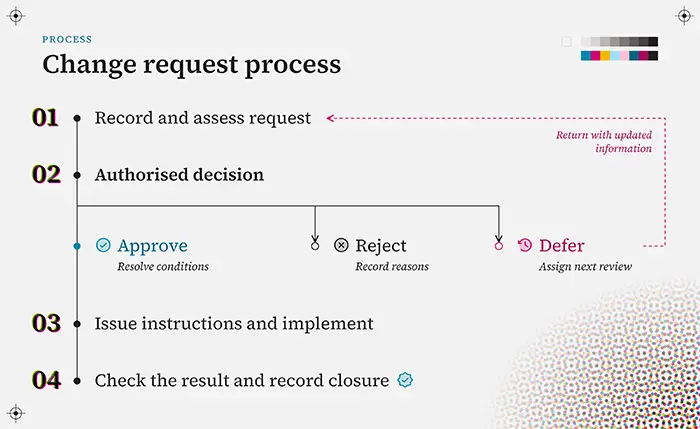
Record the decision, resolve its conditions and issue the instructions before starting the changed work.
Does the client’s feedback change the agreed work?
Compare the request with what was approved
Scope means the work and deliverables you have agreed to provide. Start with the approved brief, drawing or requirement. Ask the client what outcome they want and which part of the current proposal does not meet that need.
In the example, “make the meeting room bigger” is incomplete. Ask where the partition should move and what problem the extra space needs to solve. Keep the current approved drawing attached to the request.
Identify the type of request
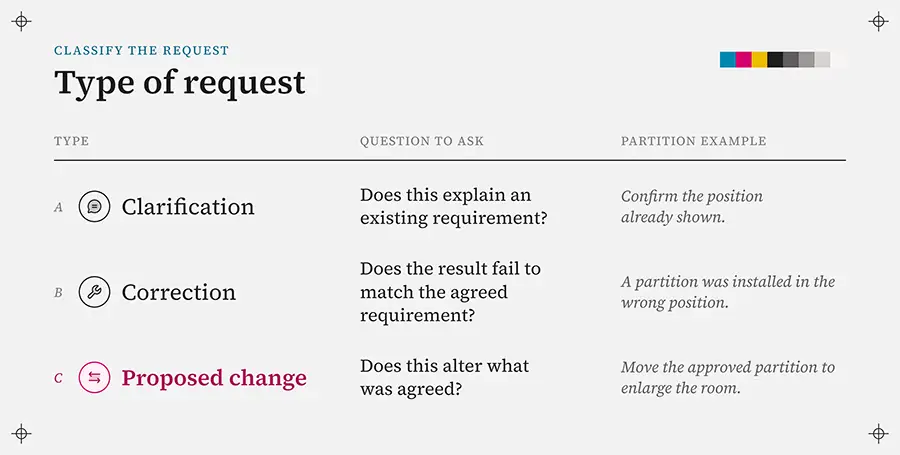
These labels help you route the question. A correction can still need formal assessment or authorisation. The label alone does not settle payment or responsibility. Refer disputed obligations to the person responsible for administering the contract.
What should you record in a change request?
Capture the request and its reason
Give each request a unique reference and record:
- The requester, date and reason for the change.
- The agreed position and the requested outcome.
- The affected drawing, requirement or deliverable, including its revision.
- The person coordinating the assessment and the decision needed.
- The supporting files, unanswered questions and next action.
For example, CR-001 could record: “Assess relocating the meeting-room partition to increase usable room space.” Its starting position is drawing MR-01, revision A. Both references are fictional. The request is awaiting assessment; cost and programme effects are unconfirmed.
Keep the form and register connected
A change-request form holds the detail of one request. A register is the list you use to track all requests. Use the same reference in both so you can find the assessment and decision from the summary row.
Use the accompanying editable form and register as a starting point. Keep the decision separate from the work status. A request can be approved with conditions and still be awaiting instructions. Record rejected and deferred requests too.
What should you check before recommending a decision?
Check the effect on the work
Look beyond the object the client mentions. In the partition example, ask the relevant designers and contractors to assess these connections:
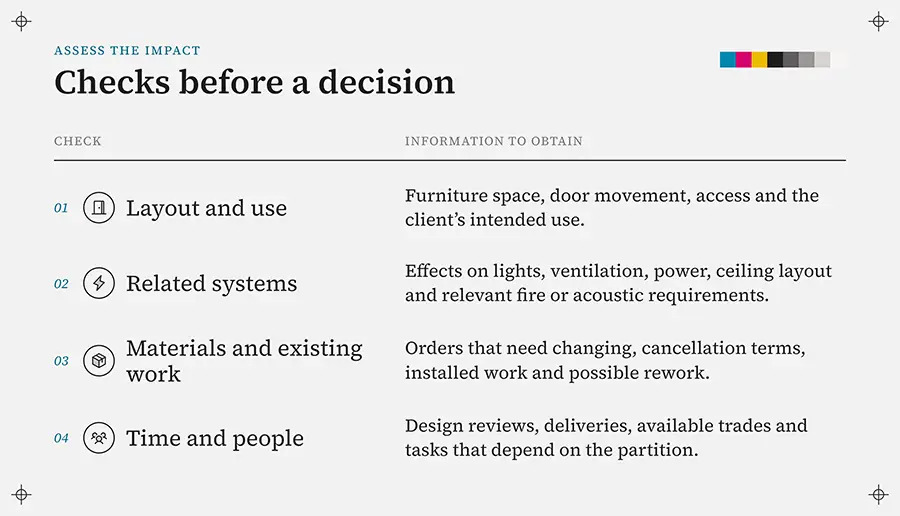
Ask the responsible specialist to resolve technical or safety questions. Hold the affected instruction if those questions remain open. A sketch showing a possible layout is not evidence that these checks have passed.
Check cost, time and alternatives
Ask each contributor to identify the basis of their estimate, its assumptions and what it excludes. Record an unconfirmed amount as unconfirmed. Do not turn a supplier’s tentative delivery date into a promised completion date.
Compare the requested move with keeping the approved layout. If a furniture adjustment could meet the same need, ask the client and designer to consider it. Present the effect of each option on the client’s stated outcome.
My guide to adjusting project resources when requirements change explores how people, time and budget connect. For this request, name the contributors you need before recommending a decision.
Who can approve, reject or defer the request?
Confirm the decision-maker’s authority
Check who can approve the design, spending and programme effects. Those decisions may sit with different people. The requester’s support does not establish that every required authorisation has been given.
PMI’s published discussion of scope management connects approval authority with instructions to begin changed work. It is historical professional guidance, not a current contract rule.
Record the decision and its conditions
Record the decision-maker, date, reasons, agreed impacts and any conditions. Attach or link the actual decision record. If the decision is deferred, assign the missing information to someone and set a review point. APM’s explanation of deferred change decisions supports recording what is needed before the request returns for review.
Suppose the authorised people approve the partition move once the revised design, quotation and programme have been reviewed. The decision record must identify those reviewed documents. If a required instruction or technical check is still pending, record that condition and keep the work status as awaiting release.
What must happen before the team starts the changed work?
Update the affected documents and plans
For the hypothetical move, check the partition drawing against the door, ceiling and services information. Update each affected document, the programme and any authorised order changes. Keep the earlier issue in the project record, marked as replaced.
My interior design drawing-package guide explains how to check related drawings and revisions together.
Issue the authorised instructions
Follow the project’s agreed route for issuing instructions. Identify the change reference, authorised scope, current revisions, conditions satisfied and work that remains on hold. Tell affected people where the current files are and record their acknowledgement where required.
For CR-001, the instruction could identify MR-01 revision B and the associated coordinated information. An approval email about the room size alone would leave the team without that detail. Do not assume approval and release happened at the same time.
My article on balancing structure and flexibility during fit-out delivery provides the wider delivery context. Here, the immediate task is to make the authorised change clear to everyone who must act on it.
How do you confirm that the change is complete?
Compare the finished work with the approved request and the agreed acceptance criteria: the conditions the result must satisfy. Record the reviewer, check date, evidence and any remaining actions. A completion message from the installer is a prompt to check the work.
In the example, the designated reviewers would check the installed position and affected work against the issued information. Keep specialist inspection or test records where required. A photograph can show visible condition; it cannot establish hidden performance or compliance.
Update the final drawings and related records before closing the request through the agreed process. The office fit-out handover checklist explains how those records connect to the information the client receives.
The same questions apply to a website project. If a client requests an extra booking step, record the intended outcome, ask the team to assess the affected pages and integrations, obtain the required decision, then check the implemented behaviour against agreed acceptance criteria.
Where can AI help with change requests?
Consider AI for organising approved-to-share feedback, preparing questions for reviewers and drafting a summary from checked records. Ask it to mark missing information instead of filling gaps with plausible answers.
Responsible people still need to verify technical consequences, costs, dates and authority. Keep sensitive project information out of tools your organisation has not approved. This is a suggested use of AI; I have not tested an AI change-control workflow for this article.
FAQs
Use the level of recording agreed for your project. A short log entry may be enough for an item within delegated authority. Check the limits before treating a change as minor, and retain any required review or approval record.
Write down your understanding and ask the requester to confirm the outcome they want. Record who said what and the affected work. Follow the agreed instruction process before acting; don’t rely on my memory of the conversation.
Identify the real deadline, the information available and the consequences of waiting. Use the project’s agreed escalation route. Record assumptions and limits. If there is an immediate safety issue, follow the site’s emergency procedure and contact the responsible people.
Record the current position, including installed work, orders and instructions already issued. Notify the responsible manager before further affected work proceeds. Assess rework and disruption, then obtain the required decision. Do not rewrite the history to make an earlier action look approved.
Record the request against the agreed work, then assign someone to assess its effects before seeking a decision. Start with that entry in your register.